




A CISO who sits through three platform demos in a week usually leaves with three different definitions of human risk management, each one fitted to what that product happens to do. This guide is for security leaders in the UAE and GCC who need to know how to choose a human risk management platform without relying on the demo that was most polished.
In short: Choose on six things you can test: the quality of the risk data, how the platform acts on it, content and language fit, where it runs, how it reports, and what a 30-day pilot proves.
Start With the Decision the Platform Supports
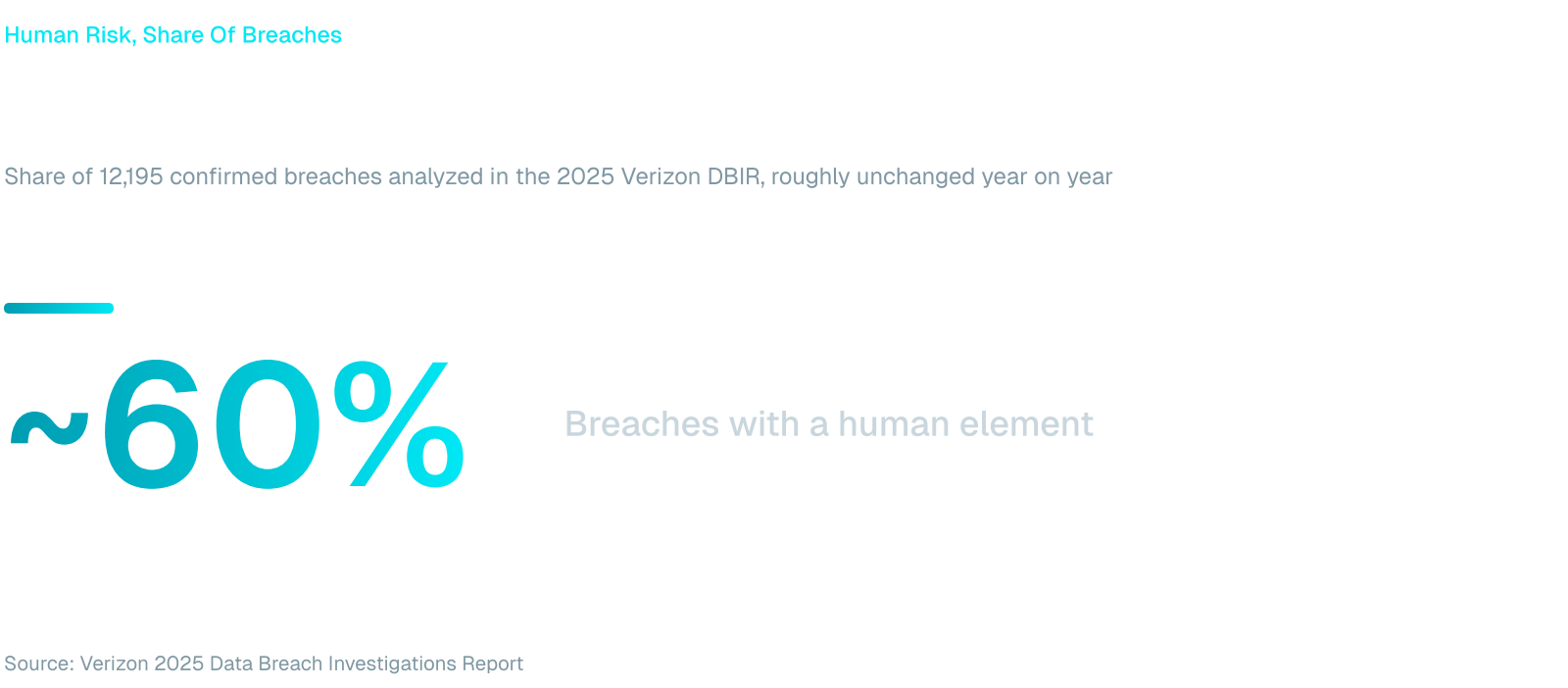
The Verizon 2024 Data Breach Investigations Report found that 68% of breaches involved a non-malicious human element, across 10,626 confirmed breaches in 2023. That is the reason the category exists, and it is also why demos blur together, because every platform can show a dashboard with people on it.

What separates platforms is whether the data changes what happens to a person next. A score that nobody acts on is a report. A score that moves a person into different training, a different simulation or a tighter control is a program, and that difference is what the rest of this guide tests for.
How to Choose a Human Risk Management Platform
Weigh these six criteria against your own organization. Each one can be checked with a question or a pilot task, so none depends on a vendor's description of itself.
- Risk data. Does the score draw on behavior, role and exposure for each person, and can you see why it changed?
- Action. When risk changes, does something happen without a person scheduling it, and do higher-stakes actions wait for approval?
- Content and language. Are Arabic and English both authored for the audience, with short lessons that fit the working day?
- Hosting and assurance. Can it run on UAE or GCC servers or on-premise, and what certifications back it?
- Measurement. Does reporting rate sit next to click rate, with repeat behavior and time to report?
- Operating load. How many hours a week will your team spend, and can it serve several entities or clients?
People search for the best human risk management tools and expect a ranked list. A ranking cannot know your regulator, your languages or your headcount, so the more useful answer is this list, weighted for your organization.
Running a Fair Platform Comparison
A human risk management platform comparison goes wrong when each platform is shown a different problem. Give every platform the same inputs: the same directory export, the same five scenarios and the same questions. Then score each criterion from 1 to 5 and weight the scores before anyone sees a price.
Weighting is where your context counts. A group with several subsidiaries may put operating load first, while a government entity may put hosting first. Think of this HRM buyer guide as the scorecard template, and keep the weights fixed once the first demo starts.
On the risk-data criterion, ask how the score is built. Odin scores each employee continuously, with individual threat profiles and weighting for role criticality. Our post on the human risk score covers what should go in, and the human risk management framework shows who owns each phase. If your team is still deciding whether you need this category at all, start with human risk management versus security awareness training.
Proof to Ask for in a Pilot
A demo shows what a platform can do on a good day. A 30-day pilot shows what it does with your people, your languages and your mail flow. Ask for these five pieces of proof before you sign.
- Pick five employees and have the vendor explain each score in plain terms.
- Simulate a risk event, such as a repeated phishing failure, and watch what the platform does next.
- Measure the time between a risky action and the response the employee receives.
- Have native Arabic readers on your staff review the Arabic content.
- Export a board-ready report and the audit trail of every automated action.
The second item matters most. In Agentic Automation Rules, the “test before you trust” feature simulates an event to show what would happen, and higher-stakes actions always wait for analyst approval. For the third item, Zero-Touch Training responds inside Microsoft Teams when a person shows a risk, with training matched to the behavior.
Operating load shows up in the pilot too. A small team that cannot plan campaigns every month should look at how much the platform runs by itself, as with Graybait, which runs phishing simulation without campaigns once setup is done.
Where GCC Requirements Change the Answer
Most buyer guides assume English-speaking staff and a cloud region that is far away. In the Gulf, the shortlist often changes on two points. The first is language, because Arabic content that was translated after the fact reads differently from content written for the audience. The second is hosting, because some entities need data to stay in the country or on their own servers.
Fraus is built in Dubai, is available in Arabic and English, can be hosted on UAE or GCC servers or deployed fully on-premise, and holds ISO/IEC 27001 certification and UAE Information Assurance (UAE IA) compliance, and is aligned with the NIST Cybersecurity Framework. Put the same hosting and language questions to every vendor.
Our posts on a cybersecurity awareness platform in the UAE and a security awareness training buyer's checklist go deeper on local requirements, and agentic AI in human risk management explains what is safe to automate.
Your Next Step Before the Next Demo
Go back to the demo week from the start. This time, send each vendor the six criteria and the five pilot scenarios before the call, and ask them to show exactly those. The demos that follow will be shorter, easier to compare and harder to polish.
When your scorecard is ready, see how Odin handles the first criterion on your own role structure.
Frequently Asked Questions
What is a human risk management platform?
A human risk management platform measures how each employee's behavior, role and exposure affect your risk, then acts on that measurement with training, simulations, policies and controls. It differs from a single training tool because the measurement drives the response, and the response changes as the person's risk changes.
How is it different from a security awareness training platform?
Awareness platforms mostly deliver content on a schedule. A human risk management platform adds continuous per-person scoring and uses it to decide what each person receives and when. Many buyers need both capabilities in one product, and the six criteria above show whether a platform really joins them.
How long should a pilot run?
About 30 days is enough to see how scores move, how fast responses arrive and how much work your team carries. It lets you run the five proof tasks with real staff, in both languages, and compare each platform on the same inputs rather than on a vendor's sample data.
What should a platform comparison include?
Use the same directory data, the same scenarios and the same questions for every platform. Score the six criteria against weights you set before the first demo, and add the pilot results last. Keep price out of the first round, so the decision rests on whether the platform changes behavior in your organization.