
National Government Cybersecurity Solutions & Training

National Government Cybersecurity Solutions & Training

Federal ministries, emirate and local government entities, and public authorities across the UAE and GCC hold sensitive information, employ officials whose names and roles are public, and often need security data to stay under national control. Fraus measures human risk across ministries, entities, and authorities, tests officials with scenarios built from open-source intelligence, and can run entirely inside your own infrastructure, in Arabic as well as English.

Government in the UAE and GCC: Phishing Is a National Security Issue

The UAE's National Cybersecurity Strategy, covering 2025 to 2031, rests on five pillars: governance, protection, innovation, building national capability, and partnership. Among its goals is a culture of cybersecurity awareness across institutions.

The threat it answers is specific to the region. In February 2026, the UAE Cyber Security Council said it had foiled organized attacks on critical infrastructure that included systematic phishing campaigns against national platforms, and the Council's head has put daily breach attempts against the UAE in the hundreds of thousands. In 2024, Trend Micro reported a sharp rise in espionage against government entities in the UAE and the wider Gulf by the group known as Earth Simnavaz or APT34. The group is known to use access stolen from one organization to attack other government bodies connected to it.

For a ministry or authority, that means a message from a trusted partner entity is no longer safe by default.

Case Study

Shamoon 2, 2016 and 2017

01

What Happened

In November 2016 and January 2017, a disk-wiping attack known as Shamoon 2 destroyed data on thousands of computers across government and civil organizations in Saudi Arabia and other Gulf states.

IBM X-Force investigators traced the entry to spear-phishing that began weeks before the wiper ran. The emails carried macro-enabled Office documents dressed up as CVs and HR paperwork, and some referenced Saudi Arabia's Ministry of Commerce and Investment. Once a recipient switched on the document's macro, the attackers had a remote foothold. They also registered lookalike domains, including one imitating the website of the Saudi Industrial Property Authority.

02

Where It Turned on a Person

Nothing in these messages asked for money, credentials, or urgency. They asked for something far smaller: to let a document display properly. Enabling a macro is a prompt many office workers have learned to click through without reading, because refusing it usually means a broken file and a delayed task. The entire intrusion was hidden behind a habit.

The institutional setting did the rest. Government staff handle a steady flow of paperwork from other ministries and public bodies, and acting on it promptly is part of doing the job well. Questioning a document that appears to come from a ministry can feel presumptuous in a hierarchy, and the attackers counted on that: a request wearing the right letterhead is rarely challenged by the person it reaches.

03

How Fraus Would Have Helped

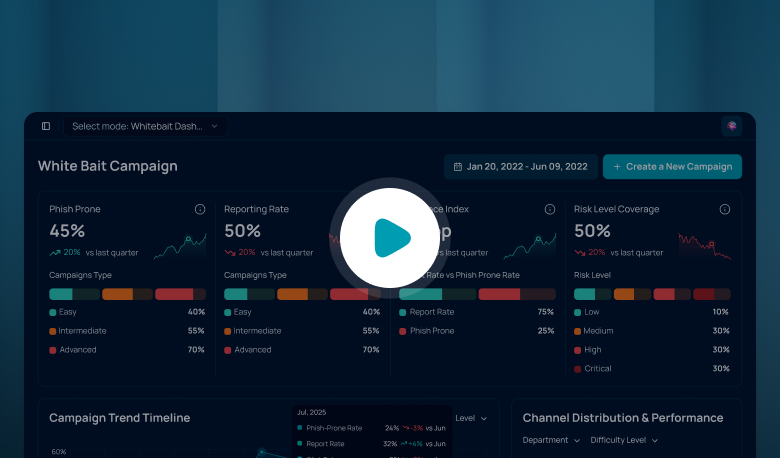
Simulations work best when they look like the mail a government employee receives every day. Fraus runs campaigns in Arabic and English, Dolus AI Studio rebuilds real lures that reached your staff into editable templates, and Whitebait's Delivery Fabric supplies the simulation domains. Inter-entity correspondence, HR documents, and recruitment pretexts can all be rehearsed safely.

Officials with public roles have public footprints. Blackbait runs OSINT reconnaissance on the people you select, shows what an outsider can learn about them, and tests how they respond under sustained, escalating pressure.

Odin applies one scoring model across ministries, entities, and authorities, with risk visible from individual officials to executive leadership and automatic escalation at critical thresholds. Codex covers deepfake awareness for impersonation of senior figures.

Fraus is built for government requirements in the region. It runs fully on-premise under national control, supports Arabic natively, and is UAE IA compliant, ISO/IEC 27001 certified, and aligned with the NIST Cybersecurity Framework.

Shamoon 2 needed one official to enable one macro. Fraus trains officials to stop at that prompt and report the document, weeks before a wiper is ready to run.

The Fraus Platform for Government

Arabic-Supported Sovereign Deployment

Arabic-Supported Sovereign Deployment

For ministries and agencies that must keep platform data in-country, Fraus runs fully on-premise with native Arabic throughout.

Explore

Odin

Odin

Hierarchical risk visibility and automatic escalation to the right stakeholders when an official's risk reaches a critical threshold.

Explore

Blackbait

Blackbait

Reconnaissance-led operations that show what an outside party can learn about the officials you select, and how those officials respond under sustained pressure.

Explore

Codex

Codex

Training in English and Arabic on deepfake awareness, business email compromise, Shadow AI, and GenAI risk.

Explore

Questions Government Security Teams Ask

Can Fraus be hosted inside our national infrastructure?

Yes. Fraus supports sovereign, fully on-premise deployment, so platform data stays under national control.

Is the platform available in Arabic?

Yes. Codex training has full Arabic and English support, Whitebait runs Arabic campaigns, and sovereign deployments include native Arabic language support.

Can we test senior officials without involving their teams?

Yes. In Blackbait you select the specific targets, and the operation then runs without further admin involvement.

Does Fraus cover deepfake impersonation of officials?

Codex includes deepfake awareness training, so staff can spot voice and video impersonation of senior figures.