
Technology companies operating onshore in the UAE process personal data under the federal Personal Data Protection Law, Federal Decree-Law No. 45 of 2021, in force since January 2022. Companies in the DIFC and ADGM free zones follow their own data protection regimes. The federal law can apply to a company based outside the UAE if it processes data about people in the country.
The risk to that data rarely starts with the product. It starts with an engineer's password, a contractor's laptop, or an approval tapped on a phone. The UAE Cyber Security Council has reported hacking attempts supported by AI, and regional analysts point out that AI lowers the cost of reconnaissance and of writing a convincing lure for one specific engineer.
Case Study
01
In September 2022, an attacker reached Uber's internal systems through the account of an external contractor. Uber said the attacker had most likely bought the contractor's corporate password on the dark web after malware infected the contractor's personal device.
The account was protected by multi-factor authentication, so the attacker sent sign-in approval requests to the contractor's phone again and again. According to accounts of the breach, the attacker then messaged the contractor on WhatsApp, posing as Uber IT, and said the requests would stop once one was approved. The contractor approved one, and the attacker moved into internal tools from there. Uber linked the attack to the Lapsus$ group.
02
From the contractor's side, it looked like a technical glitch, not an attack. Sign-in prompts kept appearing for a login they had not attempted, which is confusing, and confusion is exactly the state in which people reach for the simplest explanation offered to them. When a message arrived from someone presenting as the company's IT team, it supplied that explanation and a way to make the problem stop.
Contractors are especially exposed in moments like this. They sit outside the organization's structure, often know fewer people inside it, and have a weaker sense of what a genuine message from IT looks like, so a plausible one is harder to question. Approving a prompt also costs nothing visible: no money moves, no file opens, the screen simply goes quiet. The consequences were real, but they happened somewhere the contractor could not see.
03
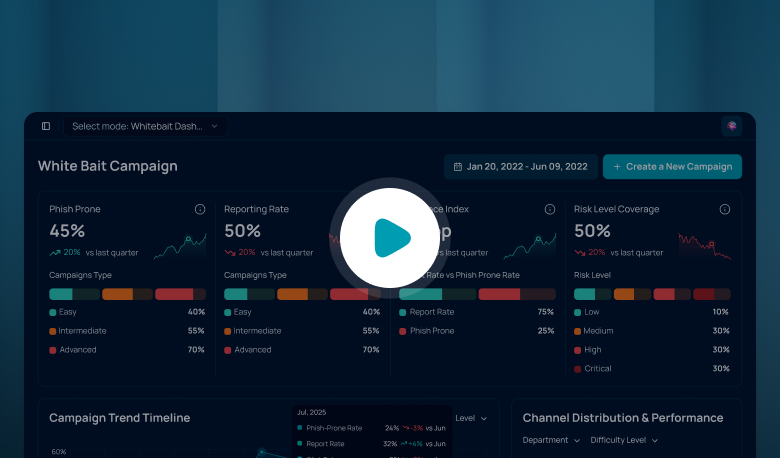
An unexpected approval request is an attack signal, and people learn to treat it that way through practice. Whitebait runs MFA-targeted simulations alongside credential harvesting and QR lures, and shows which users act on them.
Contractors with access to internal tools belong in the same risk model as employees. Odin weighs role, privileges, and user criticality, so an outside engineer with production access ranks above an employee without it, and crossing a critical threshold triggers an automatic escalation.
The WhatsApp message relied on authority and relief: IT is asking, and approving makes the noise stop. Codex training covers exactly those psychological levers, and Zero-Touch Training assigns it the moment a user's behavior shows the gap. Through the Teams App, reporting a strange prompt to security takes one tap.
The attacker already had the password. What stood between them and Uber's systems was one person deciding whether to approve one more prompt, and that is the decision Fraus trains.
Yes. Codex includes modules on Shadow AI and GenAI risk next to deepfake awareness and business email compromise, and the library is updated as new techniques appear.
Yes. Blackbait runs fully autonomous cycles after you select the targets. Whitebait also produces AI-generated campaign recommendations that arrive fully configured and stay editable before launch.
Risk scores include role, privileges, and user criticality, and Whitebait uses those signals to decide which users receive which campaign.
Yes. The Fraus Teams App brings Odin's risk scoring, phish reporting, policy acknowledgement, and micro-training into Teams.