




Most CISOs can show the board a training completion figure. Fewer can say which employees are most likely to be the way in next month, or whether last quarter's course changed anything they do at their desk. This post sets out human risk management vs security awareness training for CISOs in the UAE and the wider GCC, and shows when a team is ready to switch.
In short: Security awareness training teaches everyone the same material on a schedule. Human risk management measures each employee's behavior, scores their risk, and adjusts training and simulations to match. Make the move once you can act on individual data.
Human Risk Management vs Security Awareness Training at a Glance
Security awareness training is a program of courses, reminders and campaigns delivered to the whole workforce. NIST frames the goal in its guidance on building a cybersecurity and privacy learning program, which treats awareness, training and education as a life cycle that encourages behavior change and is measured and improved over time.
Regulators in the region expect this work. The UAE Information Assurance Regulation calls for an awareness and training program so that people understand the risks of their activities and can carry out their security responsibilities. For many GCC teams, that is where the program started, and a well-run one still earns its place.
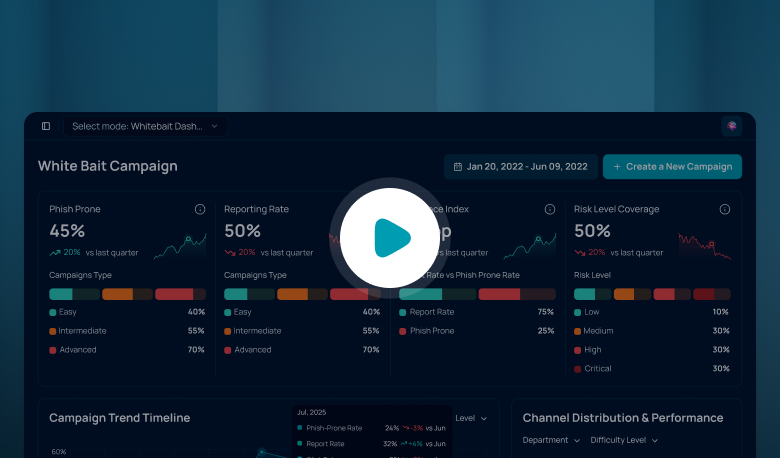
Human risk management changes the unit of measure from the course to the person. It tracks what each employee clicks, reports, ignores and repeats, weights the result by what their role can reach, and then picks the response. Training is one response among several. Fraus builds this in Odin, with continuous per-employee risk scoring and individual threat profiles.
HRM vs SAT: What Changes in Practice
Teams that compare HRM vs SAT often expect a new tool. The bigger change is in the questions the program can answer. Four differences show up in a traditional security awareness vs human risk management comparison.
What is measured. A course program reports completion and quiz scores. A human risk program reports behavior over time, such as how often a person reports a suspicious message, how quickly, and whether the same mistake comes back.
Who gets what. A fixed program sends every person the same module. A risk-based program matches content and simulation difficulty to the person's role, history and exposure, so a payments clerk and a facilities coordinator are not trained on the same lure.
How often. An annual cycle is a calendar event. A continuous program responds to signals as they appear, and training can be assigned automatically when behavior shows a gap.
Who can act. Completion rates give a CISO little to escalate. Individual scores let the team see who needs attention, route it to a manager or an automatic response, and show the board a trend. The board KPI one-pager shows how to present it.
Why Annual Cycles Miss Current Lures
The case for measuring people starts with where breaches begin. The Verizon 2026 Data Breach Investigations Report found the human element present in 62% of breaches, up slightly from 60% the year before. Attackers still go through people, and they change the way they reach them.
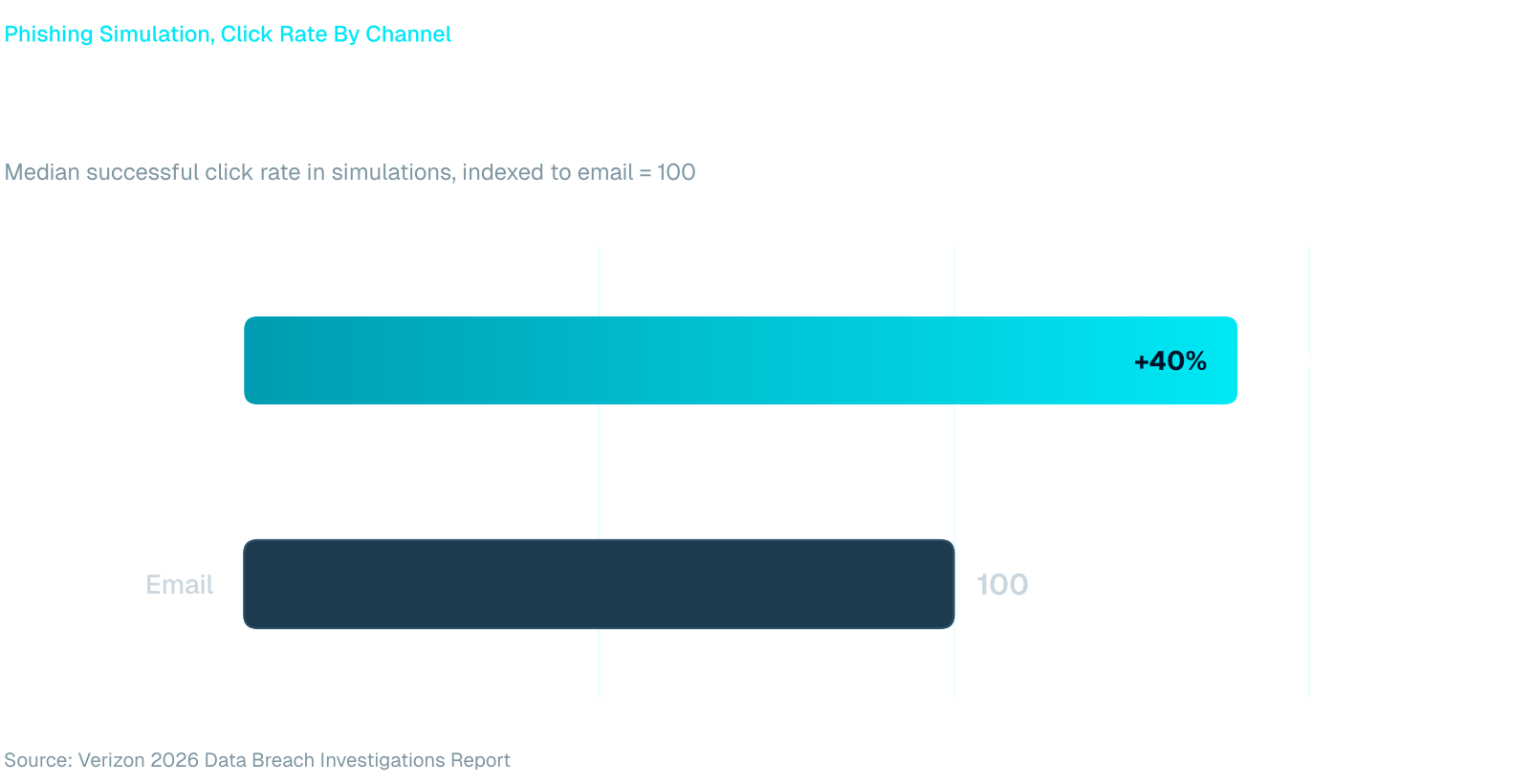
The same report shows how quickly the channel moves. In phishing simulations, the median successful click rate for voice and text messaging was 40% higher than for email.
A module written for last year's email lure does not prepare someone for a text message from a supposed courier. A continuous program can introduce new channels and scenarios as they appear, and it can set the difficulty for each person. Fraus runs this through simulations in Arabic and English, so the lure arrives in the language the employee actually works in.
Matching content to each person only works if something tells you where each person stands. That is the job of the risk score, and it is also the first thing to test when deciding whether your team is ready.
Signs a GCC Team Is Ready
Readiness is less about budget than about data and ownership. A team is usually ready for human risk management when most of these are true.
- You already record click, report and repeat behavior, even if only for simulations.
- Completion is high, yet you cannot say which roles carry the most exposure.
- Staff work in Arabic and English, and training and simulations need to match both.
- Hosting is settled, whether on UAE or GCC servers or fully on-premise.
- Someone owns acting on the scores, in security, HR or both.
If most of those are not yet true, begin with a baseline instead of a platform change. Keep delivering training, because it remains the response when a score shows a gap. In Fraus, Codex supplies the Arabic and English micro-learning, and dynamic human risk modeling supplies the continuous scoring that decides who gets it.
Where most of them hold, the move is mostly one of process. The courses you already run stay, and the schedule gives way to signals.
Start With One Role Group
Go back to the board question from the start of this post. Pick one high-exposure group, such as finance approvers, and measure it for a month: reporting rate, time to report and repeat behavior, alongside the simulation click rate. The automated phishing simulation guide explains what to keep running while you do.
At the end of the month you will know which people need a different response and which already behave well. Take that result to the board as your first per-employee risk report, then widen the program one group at a time.
Frequently Asked Questions
Does human risk management replace security awareness training?
No. Training stays in the program as one response. What changes is how it is chosen. Instead of every employee receiving the same course on the same date, scores and behavior decide who gets which training, how hard the simulations are and when. Courses become a tool inside the program rather than the program itself.
What does HRM measure that SAT does not?
SAT usually reports completion, quiz results and campaign click rates for groups. HRM adds per-person behavior over time, including reporting rate, time to report and repeated mistakes, weighted by role criticality. That lets a CISO compare people and groups by risk and see whether a response changed behavior.
Does this still support UAE IA awareness expectations?
The UAE IA Regulation asks entities to implement an awareness and training program. A human risk program keeps training in place and adds measurement and targeting. Fraus holds UAE IA compliance, and Codex includes compliance mapping for its training content.
Who should own human risk scores inside the organization?
Security usually owns the scores and the model. HR, line managers and the compliance team need access to the part that concerns them, such as policy acknowledgement or repeat incidents. Agree in advance what triggers escalation, who is told and which actions happen automatically within set boundaries.