


Forbes reported, citing a court document from a UAE investigation, that fraudsters used a cloned voice of a company director to persuade a branch manager to authorize transfers of as much as $35 million (Forbes). The manager recognized the voice, so he trusted the call. This guide to vishing awareness training is for security awareness managers in the UAE and GCC who need staff and helpdesks to verify callers even when the voice sounds right.
In short: vishing awareness training works when it gives staff one fixed way to verify a caller, a callback to a number they already hold, and gives helpdesks a written identity check that no voice, however familiar, can skip.
What Vishing Awareness Training Must Cover
Vishing, or voice phishing, is social engineering over a phone call or voice message. The target hears a person instead of a link, so the email habits of checking the sender and hovering over a URL have nothing to work on. Training has to cover a different decision: whether to act on a request from someone you cannot see.
The numbers show why this matters. The 2026 Verizon Data Breach Investigations Report finds the human element in 62% of breaches and social engineering as its own pattern in 16%. It also reports pretexting, which it describes as frequently carried out by voice communications, as the initial access vector in 6% of breaches, next to phishing at 16%.

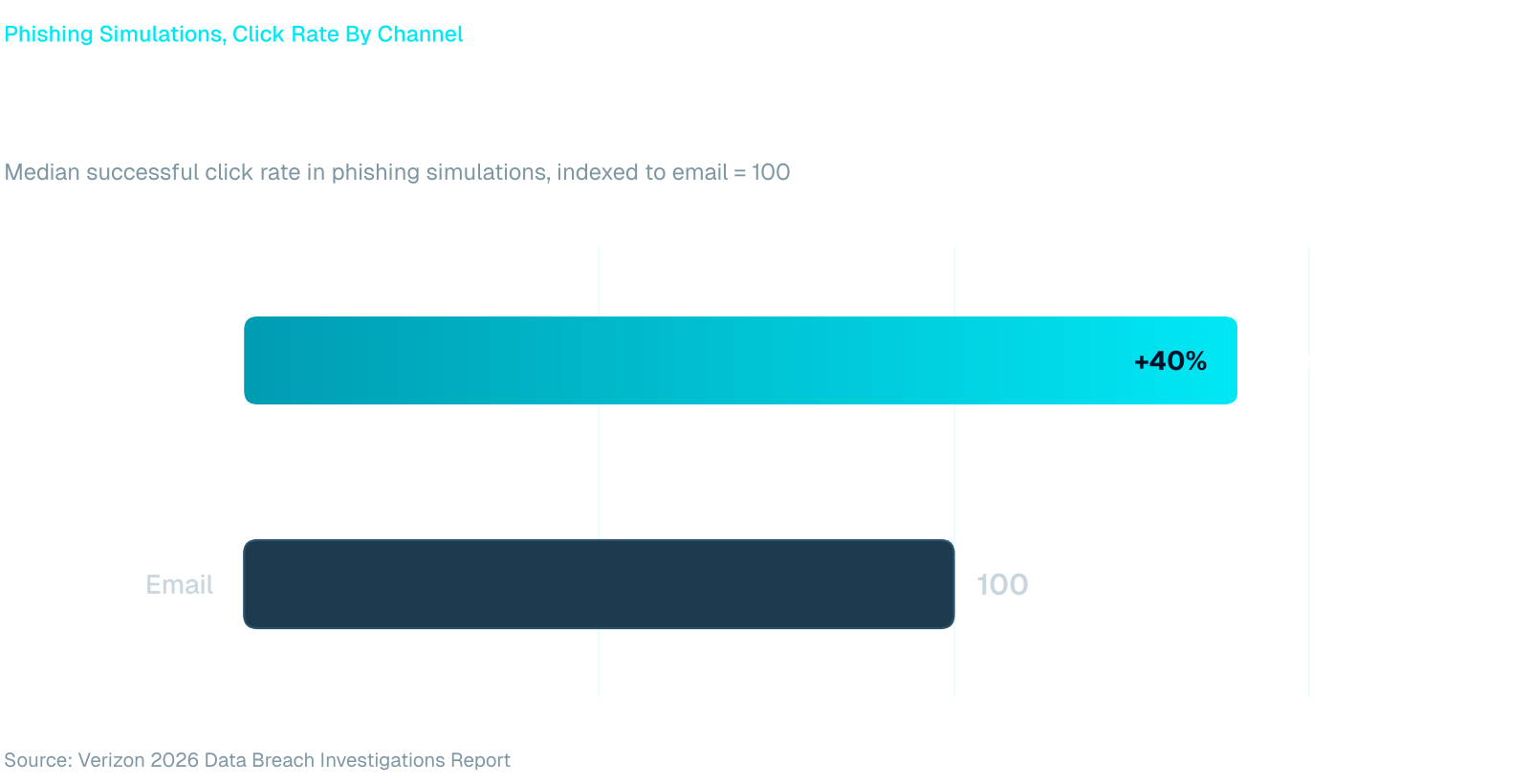
The same report notes that in phishing simulations the median successful click rate for mobile-centric vectors such as voice and text messaging is 40% higher than for email. Attackers reach people mid-workday, when attention is split. A short lesson read once a year will not hold up there, so voice phishing training needs repeated practice on realistic scenarios.
Why AI Voice Phishing Changes the Call
AI voice phishing removes the check many employees quietly relied on, which is recognizing the voice. In May 2025 the FBI warned that actors were impersonating senior US officials with text and AI-generated voice messages, and it advises people to independently identify a phone number and call to verify rather than trust the one the message gives.
The case Forbes described shows how the pieces reinforce each other. According to Forbes, the manager also received emails that appeared to confirm the transfers, so the call and the messages vouched for each other. Staff cannot judge that by ear. They need a habit that works on any channel: confirm the request through a channel the caller did not choose. Our guide to deepfake awareness training covers the video side of the same habit.
Teach the triggers instead of the sound. Urgency, a request for secrecy, and a demand to move money, share a code or reset access are the moments to stop, whatever the voice sounds like.
Helpdesk Impersonation Training for IT Teams
Helpdesks are the second target. CISA's advisory on the Scattered Spider group says it targets large companies and their contracted IT help desks, and that it uses voice communications to convince help desk personnel to reset passwords and MFA tokens. One successful reset hands over an account along with its second factor, which is why strong MFA alone does not settle this (MFA fatigue attacks shows the same gap from the prompt side).
Helpdesk impersonation training should be role-specific and rehearsed as the call itself, because an agent under a queue of tickets and a caller claiming to be a stranded executive is a live, social moment. Agree a written script and drill it until it feels ordinary:
- Verify the caller by calling back the number in the directory, never the one they give.
- Apply the same check to executives, however urgent the request.
- Treat a combined password and MFA method reset as an escalation to a second person.
- Log every reset request, including the ones refused, so patterns show up.
Fake support also arrives by chat, so cover that channel in the same lesson (see our guide to fake helpdesk chats).
Callback Rules Staff Can Follow Under Pressure
Finance clerks, executive assistants and receptionists get the calls that start these incidents. Give them a rule short enough to use while someone is pressing them for an answer:
- Say you will call back, and end the call politely.
- Find the number in the directory or on a card you already hold.
- Confirm the request with the requester or their manager.
- Report the attempt to security the same day.
Payment requests deserve a second control as well; the business email compromise training guide describes how finance teams verify bank-detail changes, and the same rule applies when the request comes by phone.
Practice makes the rule stick. Fraus Codex delivers short, contextual lessons built on real-world scenarios in Arabic and English, with role-based learning paths, and its agentic AI recommends or assigns lessons to each person from their training gaps. When someone shows a risky behavior, just-in-time coaching inside Microsoft Teams responds at once instead of weeks later.
Measure Voice Phishing Training by Behavior
Completion rates say who finished a course. They do not say whether the helpdesk refuses a reset. With leadership approval, your security team can run internal call drills in which a colleague plays the caller and the team records what the agent does.
Three measures are enough to start: the share of drill calls verified by callback, the time from the call to a report, and repeat misses by role. Pair them with the other measures in security awareness metrics so voice sits next to email in the same view.
Next Step for Your Program
Return to the call from the start: a familiar voice, an urgent request, and a person with the authority to act. Choose one helpdesk reset flow and one payment approval flow this week, write the callback rule for each, and rehearse both with the people who answer the phone. Then build the habit into role-based lessons so it does not depend on one workshop.
Frequently Asked Questions
What is vishing awareness training?
It teaches employees to recognize and handle voice phishing, meaning phone calls and voice messages that impersonate colleagues, executives, suppliers or IT staff. Good programs give a fixed verification step, such as calling back on a known number, and practice it on realistic scenarios by role.
How is voice phishing training different from email phishing training?
Email training relies on visible clues such as sender addresses and links. A call leaves no such clues and adds live pressure. Voice phishing training therefore focuses on triggers like urgency and secrecy, and on verifying the caller through a separate channel.
Can employees spot an AI-cloned voice by ear?
Not reliably. The FBI warns that AI-generated content has advanced to the point that it is often difficult to identify. Train staff to verify the request, not to judge the voice.
Who needs helpdesk impersonation training first?
Start with the people who can reset access or move money: IT helpdesk agents, including contracted ones, finance and payments staff, and executive assistants. Their calls carry the highest consequence, so they should rehearse the verification script first.