
The Gulf's energy sector has been a target for more than a decade. In August 2012, the Shamoon wiper destroyed data on about 30,000 workstations at Saudi Aramco. In October 2024, the UAE Cyber Security Council issued an alert about a campaign by the espionage group Earth Simnavaz, also known as APT34 or OilRig, against critical infrastructure in the UAE and the wider Gulf, with the energy sector as a particular focus.
In August 2026, the Council announced that coordinated attacks on the UAE's aviation, energy, and education sectors had been detected and stopped. The methods it described included targeted phishing campaigns and attempts to use employees as entry points into the environments under attack.
These campaigns seldom start in a control room. They start with an engineer's inbox, a job offer, or a partner's account.
Case Study
01
Between mid-2016 and 2017, a state-linked espionage group that FireEye tracked as APT33 sent spear-phishing emails to people whose work related to aviation, including at a Saudi conglomerate with aviation holdings. The emails were built around recruitment. They linked to files that displayed believable job descriptions, with links to genuine postings on employment websites, while carrying malicious code.
The group registered domains that imitated Saudi aviation companies and Western firms that support Saudi Arabia's military and commercial fleets. In May 2017 it used a lure advertising vacancies at a Saudi petrochemical company. FireEye also found links between the group and destructive wiper malware.
02
Most warnings about phishing describe pressure: an urgent invoice, a locked account, a demand from the boss. A recruitment approach works in the opposite register. It flatters. It arrives addressed to the person's expertise, references a role they are qualified for, and asks for nothing more than curiosity. The defenses people build against urgency simply do not engage.
It also reaches people in a private moment. An engineer weighing a job description is thinking about their career, not about their employer's security posture, and is likely to open the file on a personal device or outside working hours, away from the colleagues they might otherwise have asked. The most valuable staff in critical infrastructure are also the most courted, and the attack was dressed as exactly that.
03
Attackers start with reconnaissance, and Blackbait does the same. It runs OSINT reconnaissance on the engineers and operators you select, builds an exposure profile showing what an outsider can learn about each of them, and generates scenarios from that material instead of fixed templates.
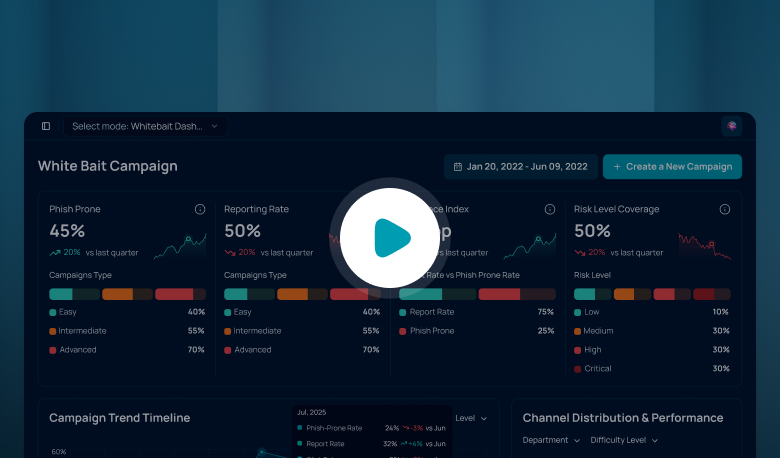
The lookalike domains and themed lures used here can be rehearsed safely. Whitebait's Delivery Fabric provides a curated pool of simulation domains, and campaigns can run in Arabic and English with difficulty raised as resilience grows. Codex covers the pressure and reward cues that make a job offer or an urgent partner request persuasive.
Odin scores people with access to operational systems by role criticality and escalates automatically when their risk crosses a critical threshold. For operators that must keep data under national jurisdiction, Fraus runs fully on-premise with native Arabic, and it is UAE IA compliant.
APT33 bet that a believable job offer would get opened. Fraus trains your people to recognize the lure, so the first one who spots it reports it to security.
Yes. With sovereign deployment, Fraus runs on-premise under your full control, with native Arabic support.
A standard campaign sends a fixed set of templates on a schedule. Blackbait begins with reconnaissance, builds each scenario around the individual target, and raises sophistication over the cycle without further admin input.
Yes. In Blackbait you select the targets. In Whitebait you control campaign design, timing, and targeting.
Codex includes deepfake awareness training, so staff learn to recognize voice and video impersonation and the pressure that usually comes with it.