


A CISO who asks for a human risk management framework usually already owns the pieces: a phishing simulation tool, an annual training module and a dashboard of click rates. What is missing is how those pieces fit together, who answers for each one, and what happens on an ordinary Tuesday when nobody is watching. This guide is for CISOs and security leads in the UAE and GCC who are setting up or restructuring a human risk management program.
In short: A human risk management framework has five phases (baseline, policy, intervention, measurement, governance), one named owner per phase, and a fixed cadence from daily automation to an annual board review. Build the loop first, then tune each tool inside it.
A Human Risk Management Framework in Five Phases
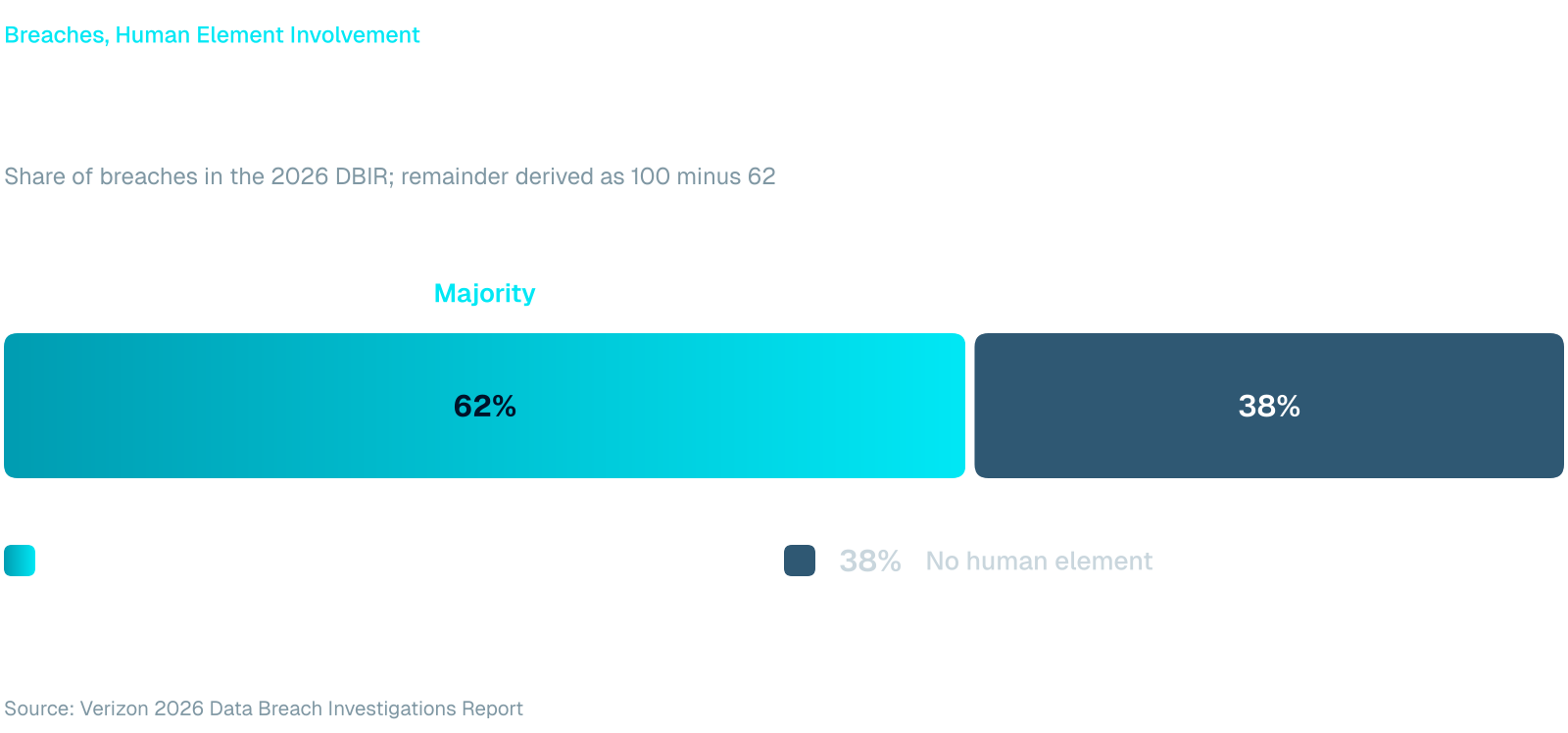
The Verizon Data Breach Investigations Report found the human element in 62% of breaches in its 2026 edition, up from 60% the year before. That share is why the program belongs to the CISO and not to a training calendar. NIST describes its SP 800-50 Rev. 1 learning program as a life cycle with ongoing, iterative improvement, and the five phases below follow the same loop.
Each phase answers one question and hands its output to the next.
- Baseline. Find where risk sits by role and department. The human risk assessment guide covers the method.
- Policy. Decide which signals trigger which response, and which responses need a person to approve them.
- Intervention. Deliver training, simulations and nudges to the person who needs them, when they need them.
- Measurement. Track risk movement, reporting behavior and repeat behavior. The human risk score post explains what goes into the number.
- Governance. Review results, approve changes and report upward.
The loop matters more than the order. Measurement feeds the baseline, so a score that stays high in finance for two quarters changes the next assignment and the next conversation with the department head. The comparison of human risk management and security awareness training makes the case for why this replaces a calendar of annual courses.
Who Owns Each Phase
A framework without owners turns into a shared inbox. Name one accountable person per phase and write the names into the program charter.
The CISO sponsors the program, owns governance and carries the numbers to the executive committee. A program owner in the security team runs the first four phases day to day. If you already have a security awareness lead, this is that role, widened from course completion to risk outcomes.
HR and department heads supply the role and joiner data that keeps the baseline current, and they agree what happens when a team stays high risk. IT and identity teams connect the directory, endpoint and identity events that feed the signals, and they own the controls behind any high-stakes action.
Legal or privacy reviews what you collect about employees and where it is stored. Fraus can be hosted on UAE or GCC servers or deployed fully on premise, which answers the residency question before it is asked.
Operating Cadence for the Program
A human risk management program depends on its rhythm. The aim is for routine work to run without anyone remembering it, so that people spend their time on exceptions.
- Continuous. Signals update each person's risk, and routine responses run through automation rules.
- Weekly. The program owner clears the escalation queue and any actions waiting for approval.
- Monthly. Review score movement by department, reporting rate and repeat behavior with team leads, using the metrics your program runs on.
- Quarterly. The CISO recalibrates role weighting, retires what is not working and refreshes policy attestation.
- Annually. Refresh the full baseline and take a board report.
Much of this can be scheduled. Fraus automation rules support weekly, monthly, quarterly and annual schedules for executive reports, policy re-attestation and risk score recalculation. Between reviews, training should not wait for a meeting: Zero-Touch Training responds the moment a person shows a risky behavior, inside Microsoft Teams.
Governance and Approval Gates
Governance is the easiest phase to skip, and it decides whether employees and auditors trust the program. Start with a one-page charter that says which signals are collected, who can see individual data, which actions run automatically and which need approval.
Approval gates deserve the most attention. Assigning a short lesson can run on its own. Anything that touches access or payments, such as step-up MFA or a finance approval hold, should wait for an analyst. Fraus lets agentic AI act in supervised or unsupervised mode, admin rules take priority, and every agentic action is logged for audit, so your internal audit team has a trail to review.
Then report in outcomes. A board rarely wants click rates; it wants to know whether risk in the most exposed roles is falling. The layout in security awareness KPIs for the board fits on one page.
Reduce Human Cyber Risk in 90 Days
A workable human risk management strategy for the first quarter is small. In weeks 1 to 3, name the owners, write the charter and connect the directory. In weeks 4 to 6, baseline the highest-impact roles first, such as finance, executive assistants and IT administrators, and weight them by role criticality in Odin before you widen to everyone.
In weeks 7 to 10, switch on automated responses for low-stakes actions and test each rule before you trust it. The risk-based training approach shows how assignments follow the score. In weeks 11 to 13, hold the first quarterly review and take the results to the executive committee.
Back to that ordinary Tuesday: with owners named, a cadence set and rules in place, nothing depends on someone remembering. This week, write the first page of the charter and put a name against each of the five phases.
Frequently Asked Questions
What is a human risk management framework?
It is the structure that turns separate tools into one program: phases for baseline, policy, intervention, measurement and governance, a named owner for each, and a cadence for reviews. It answers who decides what, when, and with which evidence, so that human risk is managed like any other risk.
Who should own a human risk management program?
The CISO sponsors it and owns governance. A program owner in the security team runs it day to day. HR, IT and department heads each own the inputs they control, such as role data, identity events and team follow-up. One accountable name per phase works better than a committee.
How often should the program be reviewed?
Routine work runs continuously through automation. The program owner reviews escalations weekly, team leads see score movement monthly, the CISO recalibrates quarterly, and the baseline and board report refresh annually. Fixed dates matter more than the exact interval, because a review that is never scheduled never happens.
How can a small team run this?
Automate the routine and keep people for exceptions. Automation rules handle low-stakes responses, and Graybait runs phishing simulation without campaigns to plan or launch. Setup takes four steps (connect the workforce, set guardrails, choose an objective, activate), and the team steps in only when the system asks.