


Every security awareness manager can name the few people who appear in every report: the ones who click the simulated invoice, approve a strange prompt or forward a message they should have reported.
The 2025 edition of the Verizon Data Breach Investigations Report puts that group at roughly 1.5% of employees in the median organization, people still clicking in simulations after all their training sessions, and one annual course treats them like everyone else. This post is for security awareness managers who want to move to risk based security awareness training, where lessons follow what each person actually does.
In short: Risk based security awareness training assigns lessons, simulations and contact frequency to each person from measured behavior and role exposure, not from a calendar. Build a score, tie each score change to a training action, and respond within days of a risky event.
What Risk Based Security Awareness Training Means
Risk based training starts from a measurement. Each person has a current risk level built from what they do: how they handle simulations, whether they report, how they respond to a warning and how exposed their role is. Lessons, simulations and frequency follow that level.
The principle is not new. NIST SP 800-50 Rev. 1, published in September 2024, says a learning program should encourage behavior change as part of risk management. Completion records show who attended. Behavior is what the program exists to change, so behavior has to drive the assignment.
Fraus builds this around Odin, which keeps a continuous risk score for each employee and weights it by how critical their role is. The score is the input, and the training is the response.
Measure Risk Before You Assign Anything
A score is only useful if you can defend its inputs to an employee and to the board. Start with behaviors that show up in daily work, then add exposure.
- Simulation outcomes: clicks and credential entries, and also reports and how quickly they arrive.
- Repeat behavior: the same person failing the same kind of lure again.
- Identity, endpoint and data loss prevention events from your own tooling.
- Role exposure: finance approvers, executive assistants and IT administrators carry more consequence per mistake.
- Training events, such as lessons left unfinished.
Keep reporting next to clicking. A person who clicks and then reports within minutes gives your team early warning that a silent non-clicker never does. For how the inputs combine, see Human Risk Score: What Goes In and What Should Follow, and for the measures to track, Security Awareness Metrics to Run Your Program On.
Personalized Security Awareness Training From the Score
Personalized security awareness training means the next lesson is chosen for this person, not for their department. Someone who keeps missing lookalike invoices gets short lessons on payment verification. Someone strong on email but weak on QR codes gets the QR scenario. Someone whose score is low and stable gets fewer interruptions.
In Fraus, Codex delivers this as agentic AI-driven micro-learning: bite-sized lessons built into everyday work, which the agentic AI recommends or assigns from each person's training gaps and behavioral signals. Codex runs in Arabic and English, so the lesson reaches people in the language they work in. The post on security awareness microlearning covers the format in more detail.
Frequency should follow risk as well. People with a high score get more contact, and people with a low score get less, within limits you set. That keeps the program proportionate: nobody sits through a course unrelated to their week, and nobody who needs help waits for a once-a-year slot.
Adaptive Security Awareness Training Responds Fast
Adaptive security awareness training changes as the score changes, and the speed of that change counts. The 2025 Verizon report gives a useful marker. In its data, employees who had training within the previous 30 days reported simulated phishing emails at about 21%, against a base rate of 5%, roughly four times higher.
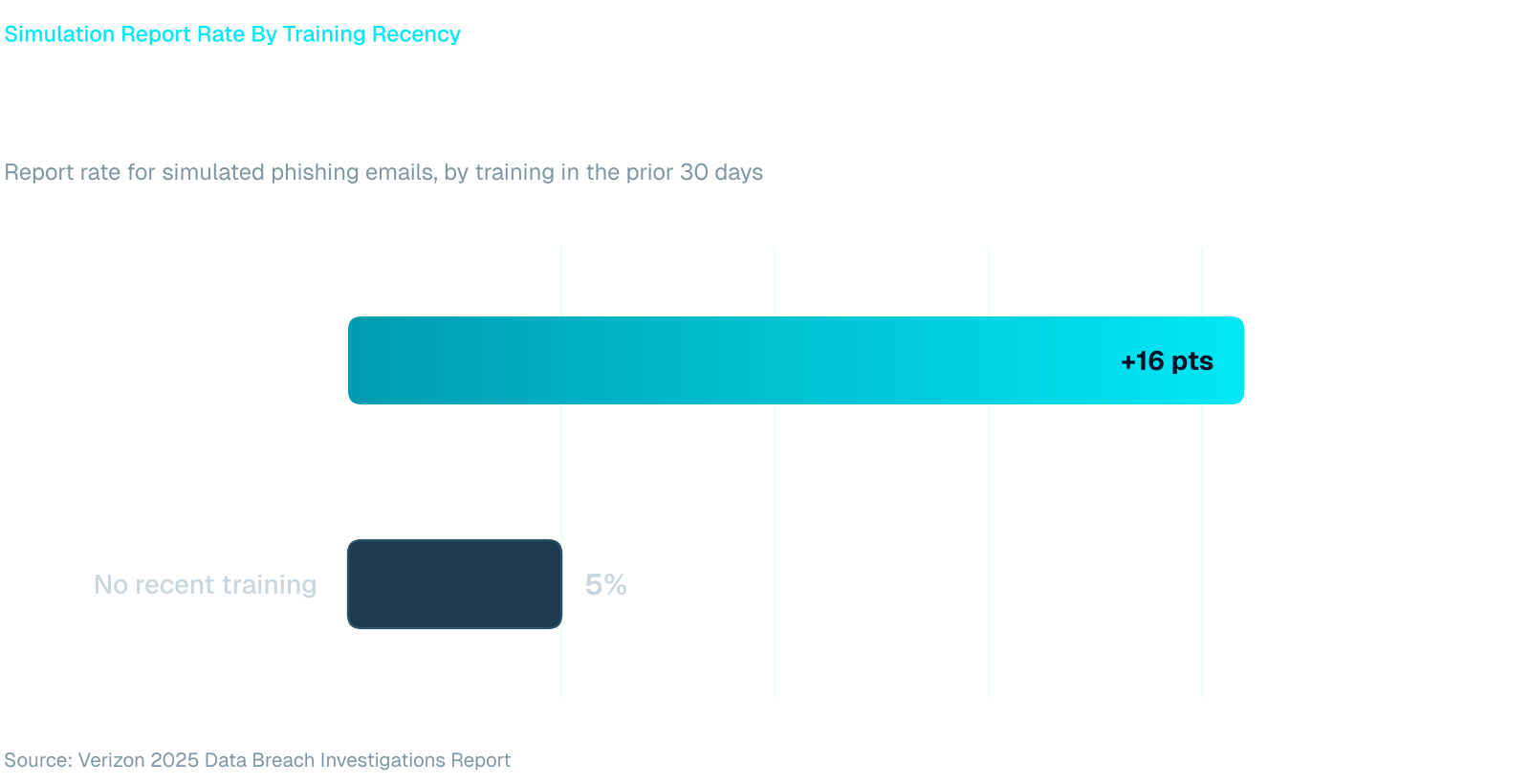
Recency is the lever. A score that updates with every event lets training arrive while the event is fresh, not at the next quarterly slot. That is the idea behind Fraus Zero-Touch Training: when a person shows a risky behavior, Fraus responds at once with training matched to it, with no manual step, inside Microsoft Teams in the flow of work. Training type, frequency and intensity adapt as the person's risk profile changes.
The mechanics are covered in Just in Time Security Coaching: Respond at the Click. What matters here is that the delay between exposure and response goes away, and your team is no longer the bottleneck.
Where Roles Fit in the Model
Role is an input to risk, not a replacement for it. A finance approver and a warehouse supervisor face different lures, and role criticality weighting in Odin makes the same mistake count for more where the consequences are larger. Within one role, though, people differ, and measured behavior decides who gets more attention.
Use role to set the starting point for a new joiner, who has no history yet, then let behavior move them. Learning paths and lures built per role are the subject of Role Based Security Awareness Training: A Practical Guide.
A First Month Plan
You do not need every signal on day one. A workable first month looks like this:
- Pick the signals you trust most, such as simulation results, reporting and repeat behavior, and agree with your CISO how they form a score.
- Set risk tiers and decide what changes in each: lesson type, frequency and who is notified.
- Turn those decisions into rules. In Agentic Automation Rules, a simulation result can assign a nudge or module and notify the employee's manager, while higher-stakes actions wait for analyst approval.
- Test each rule before you rely on it by simulating an event and checking what would happen.
- Review after 30 days: reporting rate, time to report, and whether repeat behavior is falling in the highest tier.
Go back to the few names from your reports. In a risk based program they are not a list you manage by hand. They are the first people the system reaches, with training that fits what they did. Choose your signals this week and write down what each tier should trigger.
Frequently Asked Questions
What is risk based security awareness training?
It assigns lessons, simulations and contact frequency to each person from measured risk, such as simulation results, reporting behavior, repeat mistakes and role exposure, instead of giving everyone the same course on the same schedule. The score drives the training, and the training changes the score over time.
How is it different from role-based training?
Role-based training groups people by job and gives each group a path. Risk based training adds measurement of individual behavior, so two people in the same role can receive different lessons. The two work together: role sets the starting point and the weight of a mistake, and behavior sets what each person receives next.
What is the difference between personalized and adaptive training?
Personalized training chooses content for the individual. Adaptive training keeps changing that content, its difficulty and its frequency as the person's behavior changes. A program needs both: personalization gives the right first lesson, and adaptation keeps the next one right as the score moves.
Do managers have to approve every assignment?
Not for low-stakes actions such as a nudge or a short lesson, which can run automatically. In Fraus Agentic Automation Rules, higher-stakes actions such as step-up MFA or a finance approval hold always wait for analyst approval, and every agentic action is logged for audit.