




An employee clicks a link in a payment-request email on a Tuesday afternoon. The scheduled security course that covers that exact mistake is three weeks away, and it is the same course everyone else will get. This post is for security awareness managers who want just in time security coaching: help that reaches a person while the behavior is still fresh, with nobody on the security team having to send it.
In short: Just in time security coaching answers a risky action within minutes, with a short lesson matched to that action, delivered where the person already works. Automate the trigger and the delivery, keep lessons brief, and measure whether the behavior changes.
What Just in Time Security Coaching Means
Something happens that shows a risk: a click on a simulated lure, a password typed into a fake sign-in page, a suspicious email reported far too late. The coaching arrives while the person still remembers what they were doing. It responds to a behavior instead of waiting for a date on the training calendar.
Many programs run the other way. Modules are assigned by quarter or by hire date, everyone gets the same one, and the person who clicked last week learns about it next month. Just in time security training removes that wait. Zero-Touch Training does this in Fraus: when a person shows a risk, Fraus responds at once with training matched to the behavior and no manual step. The Zero-Touch Training page explains how training type, frequency and intensity adapt to each person's changing risk profile.
What Instant Phishing Feedback Changed
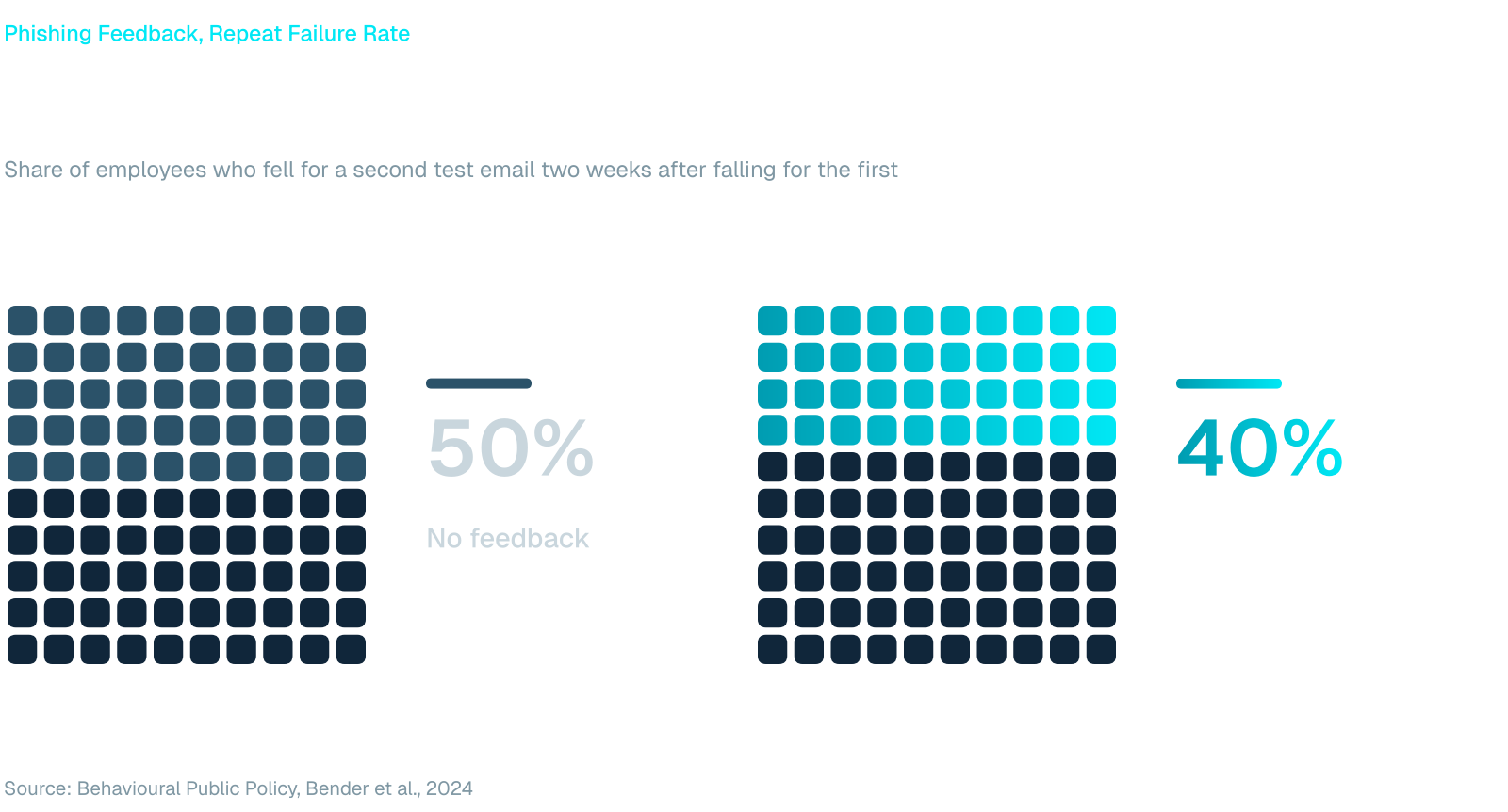
A randomized study published in 2024 in Behavioural Public Policy followed nearly 11,000 employees of a large health solutions organization in the United States. Employees who fell for a first test phishing email were split into two groups. One group saw a pop-up the moment they clicked, telling them it was a test and giving tips for avoiding phishing and reporting suspicious emails. The other saw nothing.
Two weeks later, 50% of the group with no feedback fell for a second test email, against 40% of the group that had seen the instant message. A ten point gap from one short message, compared with no feedback at all, shows what teachable moment phishing training can do.
The study also looked at people who ignored the first email. Those who received a note a week later congratulating them and stressing the importance of reporting went on to report the second email more often, 10% against 7%.
That study tested a single pop-up, once. A program can go further: respond every time the behavior appears, and change what it sends as the person's risk changes. That is the reasoning behind coaching that adapts to each person instead of repeating one message.
Matching the Lesson to the Behavior
Real time security coaching works best when the lesson fits what just happened. Someone who typed a password into a fake sign-in page needs different guidance from someone who scanned a QR code lure or approved a payment request they should have questioned. A generic reminder to be careful gets ignored by the second week.
Keep each lesson short enough to read before the next meeting: what the lure was, which detail gave it away, and what to do next time. Write it to explain and help rather than to blame, because you want the same person to report the next suspicious message. For lesson format and length, see our post on security awareness microlearning. Fraus Codex training is available in Arabic and English, so lessons can match the language people work in.
Coaching at the Point of Risk in Teams
Security coaching at the point of risk also depends on where the message lands. The lure arrived in email, and a lesson dropped into the same crowded inbox competes with everything else. Many organizations run their day in Microsoft Teams, which makes it the place where a message is read.
Zero-Touch Training delivers inside Microsoft Teams, in the flow of work. The Fraus Teams App already provides one-tap phish reporting and micro-training there, so the report and the lesson sit in one place. Nobody exports a list of clickers, builds an assignment and sends it a week later. That delay between exposure and response is what the approach removes.
Rules, Approval and What to Measure
Having no manual step does not mean having no oversight. Automation rules in Fraus take triggers from simulation results, identity, endpoint, data loss prevention, directory, training and risk score events. One rule can assign nudges, modules, videos, policies or posters, while higher-stakes actions such as step-up MFA or a finance approval hold always wait for analyst approval. See Agentic Automation Rules for the full model.
Once coaching runs on its own, judge it by the loop from behavior to change, not by course completions. NIST's guidance on learning programs, SP 800-50 Rev. 1, describes a life cycle approach that uses metrics and evaluation to keep improving the program and points it at behavior change. Useful measures for this program:
- Minutes from the risky action to the coaching message
- Repeat rate: how many coached people make the same mistake again within 30 days
- Reporting rate and time to report after coaching
- Which behaviors trigger coaching most often, by role and department
Start With One Behavior
Go back to the Tuesday click. Pick one behavior, such as entering credentials on a fake sign-in page, and write down what should reach that person within the hour. Choose the lesson, the channel, and who handles the exceptions. Run it for 30 days, then compare the repeat rate with what scheduled training gave you for the same behavior.
Frequently Asked Questions
What is just in time security coaching?
It is a short, targeted lesson delivered right after a person shows a risky behavior, such as clicking a phishing simulation. The lesson matches that behavior and reaches the person where they work. In Fraus, Zero-Touch Training does this automatically inside Microsoft Teams, so no administrator has to assign anything by hand.
How is it different from scheduled awareness training?
Scheduled training is assigned by date or role, and everyone gets the same content regardless of what they did. Just in time coaching is triggered by the behavior itself, so the lesson comes within minutes and covers the mistake that just happened. Many programs run both: scheduled modules for coverage, coaching for the moment of risk.
Does it only work for phishing?
Phishing simulation results are the clearest place to start, because the behavior is easy to observe. Fraus Zero-Touch Training responds when a person shows a security risk, and automation rules can also use identity, endpoint, data loss prevention, directory, training and risk score events as triggers. Start with one behavior, then widen.
Does the security team lose control?
No. You set the rules, the audiences and the lessons. Training and nudges can run without a manual step, while higher-stakes actions such as step-up MFA or a finance approval hold always wait for analyst approval. Review the coaching results regularly, and adjust the triggers and lessons as the data comes in.