




In a phishing study with 101 volunteers, run by a team that included authors from Harvard Kennedy School, emails written by an AI agent got a 54% click rate, the same as emails written by human experts. This post is for CISOs and security leads who need to explain what AI phishing attacks change and how to train staff for them. The study dates from late 2024, and the tools have not stood still since.
In short: AI-powered phishing removes the typos and clumsy wording employees were taught to spot. Train people to check the request, the sender and the channel instead, and test them with current, personalized lures that change as the attacks do.
What AI Phishing Attacks Change
Quality, every time. The UK's National Cyber Security Centre assessed in January 2024 that generative AI can already produce lure documents without the translation, spelling and grammar errors that often expose phishing, and expected this to increase over the following two years (NCSC assessment). The attack is still a lure that asks for a click, a login or a payment. What changes is that it now arrives well written.
In the Harvard Kennedy School study, an AI agent searched the web for each volunteer's interests, professional background and collaborators, then wrote an email around them. Those emails reached a 54% click rate, level with the human experts, and AI emails reviewed by a person reached 56%. A generic phishing email used as the control reached 12% (Heiding et al., 2024).
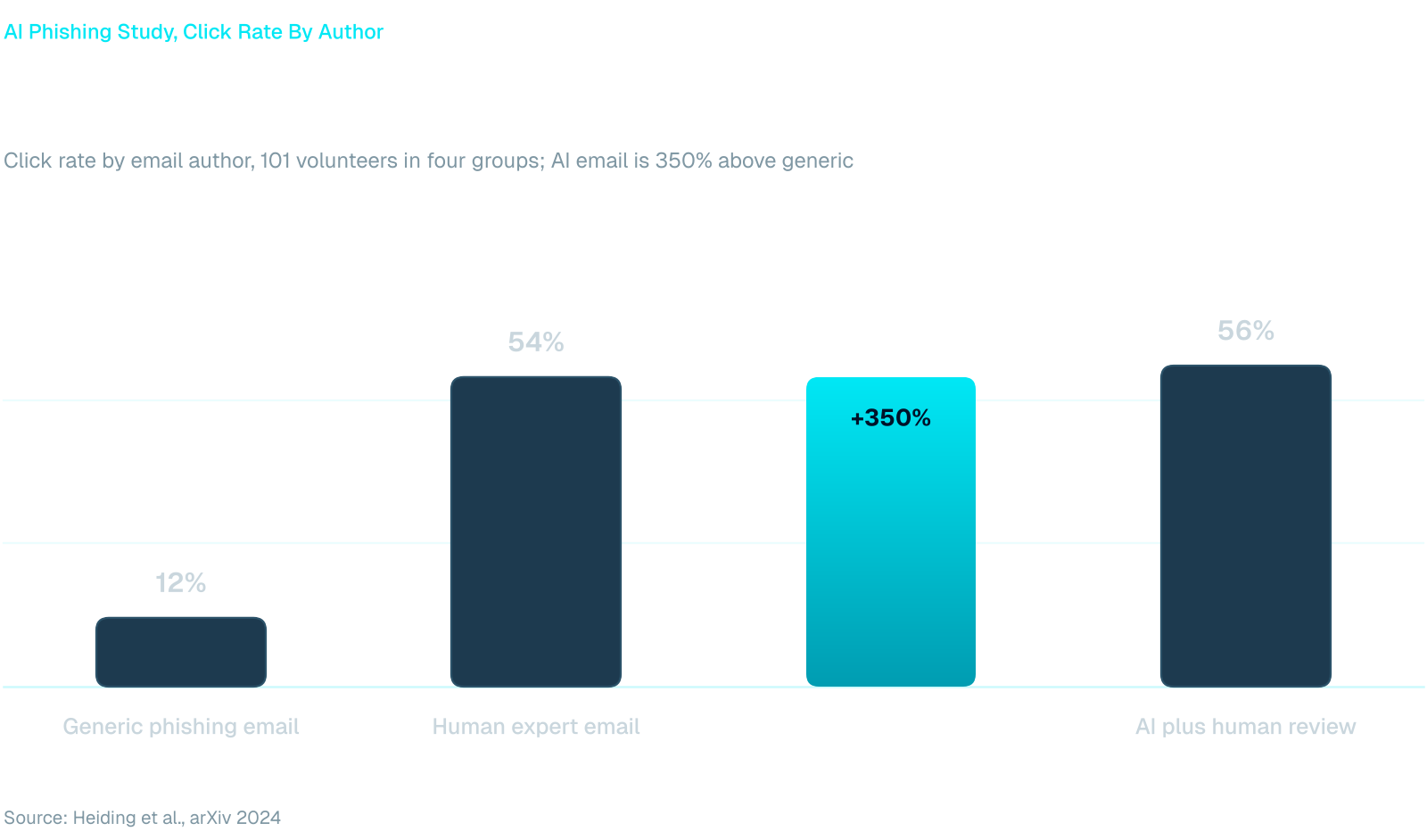
The sample was small and university-based, so read the numbers as a direction for your own testing, not a forecast. The cost side points the same way: the authors estimated about four cents in API costs per AI-generated email. Writing a personal lure no longer takes an attacker an afternoon.
Why the Old Red Flags Fail
Most awareness material still lists spelling mistakes, odd grammar and a generic greeting as warning signs. The UAE Cyber Security Council's December 2025 public advice still tells people to look for spelling or language errors. In the same messages it warns that criminals use AI to impersonate individuals and institutions with growing realism (Gulf News report). A message can pass the spelling check and still be hostile.
The NCSC went further and warned that generative AI will make it hard for everyone to spot phishing, spoofing or social engineering attempts, regardless of their cybersecurity knowledge. For staff who read both Arabic and English, translation slips were one more tell, and those are among the errors the NCSC says AI removes.
That moves the useful question from “does this look wrong?” to “should this request exist?”. A change of bank details, a login prompt behind a link, a request to keep something quiet and a demand for speed stay suspicious however well they are written. The Council's April 2026 awareness campaign makes a similar point when it calls the human element the most critical component in cybersecurity (Gulf News report).
Training for AI-Powered Phishing
Training that works against AI-written lures teaches a short routine employees can run in the few seconds they have. It does not depend on the message looking odd.
- Ask who is writing, and whether they normally contact you through this channel.
- Look at what is requested: money, credentials, secrecy or speed.
- Confirm through a second channel you already trust, never the one inside the message.
- Report the message, including when you have already clicked.
Simulations need to move the same way. A fixed template library written two years ago still tests the old red flags. Whitebait runs AI-recommended campaigns in Arabic and English, and Dolus AI Studio turns a screenshot of a real suspicious email, or a short prompt, into an editable template, so the lure that reached your staff this week can become a simulation template.
For the roles you rate as most exposed, Blackbait runs OSINT reconnaissance on selected targets and escalates attacks autonomously. That is closer to what the study's AI agent did than a broadcast campaign is.
Measuring Generative AI Phishing Readiness
A click rate on its own says little once the lures look clean. Track the reporting rate next to it, along with how long reports take and whether the same people repeat the same mistake. The method in Phishing Simulation UAE: What to Check Before You Buy shows what to ask of any platform, including whether it tracks reporting rate next to click rate.
Difficulty should follow the person, not the calendar. Our post on adaptive phishing simulations covers how to raise or lower the challenge by role and past behavior, which is how a program keeps pace with attackers who personalize.
Next Step for Security Leaders
Take the lure your own staff reported most recently and check whether it contains a single spelling mistake. If it does not, your simulations should not either. Rebuild that lure as a template, send it to one department, and compare the reporting rate with your last campaign. The gap between that result and your old template is the size of the problem.
Frequently Asked Questions
Can employees still spot AI-generated phishing emails?
Sometimes, but not by looking for mistakes. The NCSC expects generative AI to make phishing, spoofing and social engineering hard for everyone to spot, whatever their cybersecurity knowledge. Employees do better when they check the request itself: who is asking, what they want, and whether it can be confirmed through a second channel they already trust.
What is generative AI phishing?
It is phishing in which a generative AI model writes or personalizes the lure and sometimes researches the target. In the Harvard Kennedy School study, an agent built profiles from public web sources and wrote each email around them. The goal is unchanged: a click, a login or a payment. The writing is faster, cheaper and cleaner.
Do we need new training for AI-powered phishing?
Keep the fundamentals and change the examples. Replace error-spotting with request checking, refresh lures so they match what attackers send now, and set difficulty by role. Deliver it in the languages your staff work in, and measure reporting and repeat behavior, not only whether people clicked.