




Invoice fraud in UAE construction often arrives as an ordinary supplier email asking to update bank details shortly before a payment falls due. This post is for finance controllers and CISOs at contractors and developers who want to see how the scam works and how to test the step where it succeeds.
In short: Criminals read genuine supplier email, then ask the paying team to send payments to a new account. Abu Dhabi Police warn against paying on an email alone. Confirm every change by phone on a number on file, and use simulation to check that teams do.
How the Bank-Detail Change Attack Works
On 8 October 2026, Abu Dhabi Police warned companies about fake emails that impersonate legitimate beneficiaries and business partners and ask them to change bank account details. Payments and outstanding amounts then go to the new account. Police said the scam often goes unnoticed until after the money has been transferred, as Gulf News reported.
Police added that fraudsters use genuine business correspondence to make the change request look legitimate. The Gulf News explainer published with the warning sets out the pattern in four stages.
- Criminals compromise a vendor's or employee's email account, or register a fake domain that closely resembles a real one.
- They read the correspondence to learn about invoices, payment dates and who deals with whom.
- Shortly before a payment is due, they ask for it to go to a new account, sometimes citing a genuine invoice number or official-looking documents.
- The fraud may surface only when the real supplier chases the unpaid invoice.
The explainer also lists warning signs, including urgency, a slightly altered sender address, a change with no prior notice, avoidance of phone verification and a bank in a different country from the supplier's usual location.
Construction has seen the same pattern elsewhere. The Australian Cyber Security Centre described scammers who pose as a legitimate business, write to its customers and ask them to change the bank details used for future invoice payments. It noted that the fraud can go unnoticed for weeks or months, until the construction company follows up on missing payments.
Invoice Fraud in UAE Construction Chains
A UAE project pays through a chain. A developer pays a main contractor, the contractor pays subcontractors and suppliers, and consultants certify the work along the way. Each link holds a mailbox that a criminal could read, and no link can see how well the others protect theirs.
Your controls do not cover their inbox. In 2015, Middle East Construction News reported that fraudsters targeted a customer of Dubai's Construction Machinery Centre (CMC). The customer's private email account was allegedly broken into, and criminals posing as a CMC representative asked for a genuine bill to go to their account. CMC's own networks were not breached. The customer started the transfer before the attempt was identified and blocked.
Two parties, one missing payment. A Dubai case reported by Gulf News in 2025 began as a Dh23,000 payment dispute. One company said it had paid and held transfer records, and the other said it never received the money. Investigators found that an intercepted and altered email exchange had changed the payee account.
The UAE Cyber Security Council says more than 75% of cyber breaches begin with phishing emails or fraudulent messages, according to Gulf Today. A bank-detail change request is one of those messages, written to look like routine supplier correspondence.

Controls That Close the Gap
The decision that matters is small and human. Someone in accounts payable, procurement or a project office decides whether an emailed request is enough to change a supplier's bank details. Criminals send the request shortly before a payment is due, so it arrives with a deadline attached.
Abu Dhabi Police urge companies not to transfer money based solely on emails requesting changes to bank account details, and to strengthen internal verification procedures. Their advice and the protection steps in the Gulf News explainer include the following.
- Verify every bank-detail change by phone, using a number already on record rather than one in the email.
- Require approval from more than one authorized employee.
- Strengthen email security with DMARC, DKIM and SPF.
- If fraud is suspected, contact your bank at once and ask whether the transaction can be recalled.
- Report it without delay through Abu Dhabi Police's Aman service on 8002626, by text to 2828 or at aman@adpolice.gov.ae.
- Train the employees who handle finances and correspondence.
Add one rule that fits a project chain. Take the phone number from the contract or from an earlier verified payment, and record who called, which number they used and when.
Test the Change Step With Simulation
Written procedures only hold when people follow them under deadline. A simulated bank-detail change request shows what a finance or project team does when one arrives, before a criminal sends the real one.
Fraus Whitebait runs phishing simulations with Arabic and English templates, so the request can arrive in the language your suppliers use. Dolus AI Studio turns an email screenshot or a prompt into an editable template, so a scenario can match the tone of your own supplier emails.
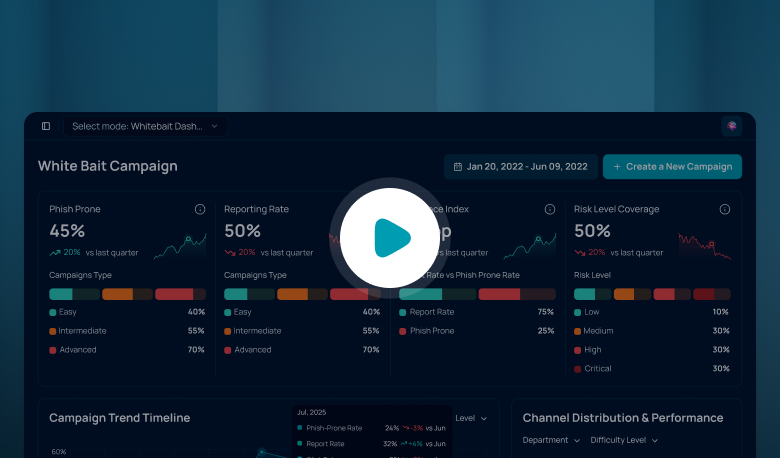
Measure the response. Whitebait tracks reporting rate next to click rate. For this scenario the reporting rate is the number to watch, because a report is how the rest of the company learns about a suspicious request.
Weight the roles that hold the keys. Odin scores human risk for each person and weights it by role criticality, so staff who can change supplier details or release payments count for more than their colleagues. A repeated miss escalates automatically instead of waiting for the next review.
Matching each person's role and difficulty level, and running the scenario on a continuous cadence, keeps the change step in front of the people who handle it. The Fraus page for construction and development shows how this applies across the project chain, and the post on automated phishing simulation explains how a program runs through the year.
Run a Check on Your Last Ten Changes
Start with your own records. Pull the last ten supplier bank-detail changes and look for the call, the number used, the second approval and the date. Any gap shows where the process relies on one person's judgment.
Then pick a pilot group such as accounts payable and project accounts, run a simulated change request, and review the reporting rate with the head of finance. If you want to see this scenario run for your own teams, talk to Fraus about a demo.
Frequently Asked Questions
How do fraudsters redirect supplier payments by email?
They take over or imitate a supplier's or employee's mailbox, read the invoice conversation, and send a message shortly before payment is due asking for a new bank account. The message may quote a genuine invoice number. The fraud may surface only when the real supplier chases the unpaid invoice, sometimes weeks or months later.
How do we verify a supplier's change of bank details?
Phone the supplier on a number you already hold, never one from the request, and require more than one authorized employee to approve the change. Abu Dhabi Police warn against transferring money based solely on an email that asks for new bank details. Take the number from the contract or an earlier verified payment, and record who called and when.
Who bears the loss when a client pays a fraudulent invoice?
There is no single answer, because it depends on the contract and the facts of the case, so involve legal counsel early. In a Dubai case reported in 2025, one company said it had paid and the other said it had not been paid. The dispute went to Dubai's Centre for Amicable Settlement of Disputes and was referred to cybercrime authorities, and the companies agreed to settle.
What should we do if we have already paid a fraudulent invoice?
Contact your bank immediately and ask whether the transaction can be recalled, then report it without delay. In Abu Dhabi you can use the Aman service on 8002626, by text to 2828 or at aman@adpolice.gov.ae. Do not reply to the message or send further money, and confirm the correct details with the genuine supplier by phone.